Showing posts with label History. Show all posts

Friday, August 14, 2015

Nicos Ploumbides: The letter, the body, the life

Ploumbides' letter, 14 March 1952
14 March, 1952. Nicos Belloyannis, Dimitris Batsis, Nicos Kaloumenos and Elias Argyriades have been sentenced to death as enemies of the state and Soviet spies. A letter arrives in the offices of the newspaper "Proodeftiki Allagi" [Progressive Change]. It is signed by member of the KKE CC and PB and director of the party's organizational structure in Athens and Piraeus, Nicos Ploumbides. He is in hiding from the revanchist post civil war Greek state. It is published two days later. The letter reads (transcription follows original notation):

Dear General Editor,
I am sending you a copy (handwritten) of a letter I have sent to the lawyers of my comrade, Nicos Belloyannis, and I beg you to publish it. I give you and the GREEK PEOPLE my promise to present myself and stand trial if the death sentence on Belloyannis is repealed.
Sincerely,
Nicos A. Ploumbides
Member of the CC of the KKE
Athens, 14 March 1952 
---

What is "the Left"? Ten remarks

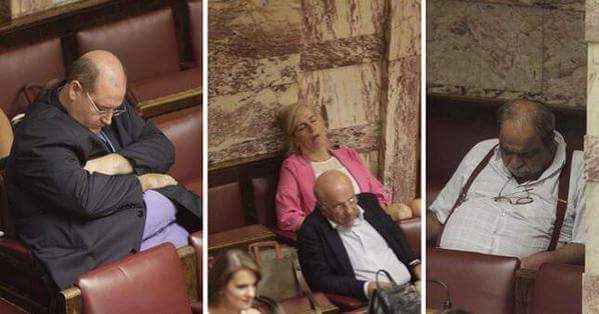
SYRIZA MPs sleeping in Parliament during "fast-track" imposition of the third Memorandum by their Party
What is "the Left"? Ten Remarks
Originally published in Greek, in Lenin Reloaded, 21 June 2014

1. In Greece, "the Left" exists since 1951, and the foundation, during that year, of the United Democratic Left (EDA). As a category of political thinking, it had no significance in the country in the period before the 1950s. "Anarchism" was far more important as a designator of ideology at the beginnings of the Greek worker movement than "the Left" -- not to mention the significance, for an anti-bourgeois politics, of terms like "Bolshevism" and "Third International". Structurally, the precondition for the birth of "the Left" was the self-censorship of the self-designation of a sector of the population as "communist" as a result of state terror. "The Left" is born under conditions of state repression as a defensive misnomer and as a pseudo-apellation for purposes of self-protection.

2. The defeat of the Democratic Army of Greece (DSE), in combination with state terror and repression, however, also created the preconditions for the pseudo-category of "the Left" (as a nominalist abstraction, rather than as a concrete designator of a tendency within a worker-socialist party -- a use with an entirely different genealogy) to acquire its own substantive meaning. It created, to put it more simply, the possibility for a section of the communists to really (and not just superficially) make the transition to "democratic ideology", which in conditions of unshakeable capitalist domination necessarily means the transition to the side of bourgeois democracy. "The Left" is the product of the effective surrender of a section of the communists to the victorious bourgeois state.

Saturday, May 2, 2015

1st May 1944-30 November 2014, Kaisariani

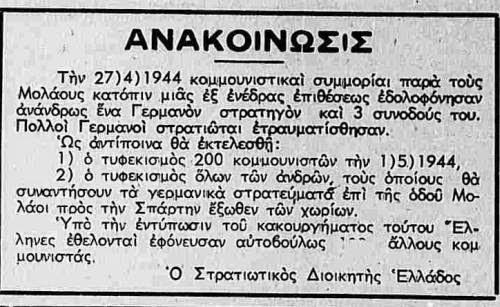
Announcement

On 27/4/1944 Communist bandits ambushed and murdered, in unmanly fashion, a German general and three of his entourage in Molaoi, Sparta. Many German soldiers were injured.

In retaliation, we shall:

1. Shoot 200 Communists on 1/5/1944,

2. Shoot all the men the German troops encounter on Molaoi, on the way to Sparta, in the surrounding villages.

Under the influence of this crime, Greek volunteers [Nazi collaborators] have willingly murdered 100 more Communists.

The Military Commander of Greece.
***
Historian Menelaos Haralambides on the Kaisariani executions:

Friday, May 1, 2015

KKE Portal: On the 40 years since the liberation of Saigon

This year, on April 30, we commemorate the 40th anniversary of the heroic victory of the Vietnamese communists and the people of the country, when American imperialists were forced to evacuate even their Embassy in Saigon, the capital of "South Vietnam", and to withdraw their last troops.

In one of the bloodiest and longest wars, where more than 3 million Vietnamese were killed, while major parts of the country and its infrastructure were destroyed, the forces of the People's Republic of Vietnam, joining forces with the rebels of the revolutionary government in the South, achieved military victory and hence liberated the South and opened the path for the construction of a united country.

This was preceded in September 1945 by the defeat and withdrawal of Japan (which occupied Vietnam) and the declaration of the People's Republic of Vietnam in the North, which was faced with the French colonialists-imperialists' declaration of war and the legendary victory of the Viet Minh in the battle of Dien Bien Phou, under the leadership of Ho Chi Minh and general Võ Nguyên Giáp, in 1954.

Monday, March 30, 2015

From Nikos Beloyiannis' defense in his two trials

KKE Berlin honors the memory of Nikos Belogiannis, 29 March 2015
(First trial, November 1951)

The responsibility for the fact that the land of Greece is full of graves and ruins lies exclusively with the foreign imperialists and their Greek servants. [...] We love Greece and its people more than our accusers. We have shown it when its liberty, independence and integrity was at risk, and we have fought so our country can live through better days, without hunger and war. This is the purpose of our struggle, for which, when it is necessary, we lay down our lives. I believe that by trying us today you are trying the struggle for peace. You are trying Greece. [...] The organizers of this trial, Greeks and foreigners, have undertaken unprecedented efforts to slander the struggle of the KKE, without hesitating to distort well-known texts. [...] Yet it was proven despite all this that the KKE is a patriotic party, with national deeds no other party can present. Because it has offered tremendous hetacombs to the altar of Greek independence and freedom. [...] For this reason, the bullets of the execution squad will not murder us. They will murder the peace and honor of Greece.

(Second trial, February 1952)

This is the freedom of communists: this is the freedom to struggle in order to overthrow class slavery under any conditions. From this grows the strength and stamina of communists. This strength illustrates the values of our struggle, of disinterest in our daily and relentless contribution, whose only payback is the justification given by fulfilling one's duty: the fight against the system until its overthrow, so that a communist society can be built.

KKE "of the Interior"

In 1968, and in response to their interpretation of events in Czechoslovakia as a "Soviet invasion" during the party conference that took place in Budapest (KKE was banned in Greece and many of its members lived in exile), a number of the members of KKE expressed their disagreement with the party majority and left the party. They were joined by a number of party members living in Greece, and continuing party activity in a clandestine manner. 

Those who left KKE called their party "KKE of the Interior" (ΚΚΕ Εσωτερικού), suggesting that everyone who had stayed loyal to KKE was a member of a "KKE of the exterior", that is to say, a Soviet Union operative rather than a true Greek. To emphasize their point, their party emblem featured the Greek flag behind the hammer and sickle which was the emblem of the KKE.

Nicos Poulantzas, then living in Paris, France, became the most important intellectual voice of the "KKE of the Interior", whose orientation was, however paradoxically for a party that pointed at others as "suspiciously internationalist", Eurocommunist, and in line with Italian and Spanish Eurocommunism. Of course, the "internationalism" the KKE "of the Interior" rejected was socialist internationalism; the internationalism it upheld was the "internationalism" of the west European left.

Sunday, March 29, 2015

"Avgi" on the NATO war on Yugoslavia: "Srebrenitsa", 9/7/2005

From KKE obstruction of NATO train missions to Yugoslavia
The following article was published in the newspaper "Avgi" (Αυγή) on the 9th of July 2005. At the time of the article's publication, SYN, the basic party "Avgi" expressed, had already become the main constituent party of SYRIZA, which was founded in 2004. Its author, Dionysis Gousetis, later abandoned SYN to become a candidate for the neoliberal party "Action-Liberal Alliance." Like many others, the article is no longer accessible in "Avgi's" newspaper archives, but it is hosted by a neoliberal site associated with Mr. Gouseti's later alliances, and both its original venue and the date of publication are clearly visible.
***

What is a genocide? It is the most hideous of crimes: you kill the other exclusively on the basis of what they are. Srebrenitsa, 11 July 1995; ten years ago to the day; the first genocide in Europe after the Jewish and Roma Holocaust  in Hitler's hands; Srebrenitsa; 8,000 Muslims dead because they were Muslim; Srebrenitsa; a wound that remains open as long as those responsible remain unprosecuted; Srebrenitsa; the wound of civilized Europe.

Tuesday, March 17, 2015

Aleka Papariga-The CP position of refusing to participate in bourgeois government (Pt. 2)

Pt. 1.

In conditions of rapid deterioration of the people's standard of living and while the workers' movement -- despite its important struggles, ones with a broader resonance in Europe -- still lags very much behind in terms of organization and impact, the bourgeoisie manages, despite its own dead-ends, its own difficulties in managing the crisis and in achieving a speedy economic recovery, to maintain the stability of its power. Indignation and rage may grow, yet class consciousness may well lag behind in such conditions. In these conditions, there are grounds for both radicalization and roll-back, decrease of demands. This second trend is currently powerful, whereas radicalization does occur, but in a slow pace and with setbacks.

In these conditions, the formation of a coalition government, based on the prestige of the KKE, appeared to be something positive or at least as a lesser evil.

Thursday, March 12, 2015

Aleka Papariga-The CP position of refusing to participate in bourgeois government (Pt. 1)

Aleka Papariga
The CP position of refusing to participate in bourgeois government
Communist Review 2012, issue 2
Translation to English: Lenin Reloaded

First, please allow me to elaborate on the rich experience the KKE has garnered from its participation in bourgeois governments, an experience that is even richer when it comes to Europe more broadly. This doesn't concern very special cases, but facts and results that offer generalizable conclusions and that confirm one thing: that in the period of the transition from capitalism to socialism a CP has no reason to take responsibility in a bourgeois government or, more generally, in a government of bourgeois management. For as long as the working class and its allies have not taken power into their hands, the CP must be an oppositional power and use that position to enact its vanguard role in the movement, exploiting of course all available forms of struggle -- including the bourgeois parliament.

Participation in a bourgeois government is a mistake that cannot easily be redressed and that may prove impossible to redress.

Wednesday, March 11, 2015

An interesting dialogue between SYRIZA, KKE and Golden Dawn MPs, Greek Parliament, 10/3/2015


Maria Kanellopoulou (SYRIZA): …. But the thousands of Wehrmacht troops, the SS, the Gestapo, the Luftwaffe and tanks that drowned Greece in blood didn't come from the moon, nor from Sirius, nor from Thule, as their local epigones claim -- parenthetically, they don't pretend to be patriots, they celebrate Hitler's birthday and tattoo themselves with swastikas. [...] The Greece on which we are deciding has been borrowed from the youth, like Pavlos Fyssas, who was murdered by the epigones of the Nazis, those who dismantled the country 40 [70] years ago. To them we owe the truth. To them we owe the [war] reparation.

Michael Arvanitis-Avramis (Golden Dawn): Ms Chair of Parliament, how can you allow her to talk like that? Recall her to order! She has no right!

Maria Kanellopoulou: And it's of blood. To them we owe.

Kostas Skolarikos: On December 1944, Radio Interview, 3/12/2014 (Part 1)

Journalist: We referred then, in our introduction, to December 1944, and we will explore this issue a bit further, since the Communist Party of Greece has launched a process of re-approaching and re-reading history, if you wish. So, we will have a look at the basic aspects it indicates in this re-reading. Let me welcome Mr. Kostas Skolarikos, who works at the History Department of the Central Committee of the KKE. Good morning, Mr. Skolarikos.

Skolarikos: Good morning. Let me initially point out that this isn't a re-reading, because the KKE has never ceased trying to examine its history -- and its history is a part of the history of modern Greece as a whole. This rather concerns the lessons we can draw today, under the light of new sources and archives that have been published. This is then the process in which the new book published by our party is embedded. I'm referring to the volume December 1944: Crucial moment of the class struggle, where one can find data on December, as well as some testimonies on the campaign of dynamiting the hotel Grande Bretagne [British Army HQ in Athens], and diverse other elements of the period.

Nikos Kyritsis-The Democratic Army of Greece (Book Review)

The Democratic Army of Greece: Foundation, Units, Officers, Forces, Losses, Social Composition
By Nikos Kyritsis
Book Review, Rizospastis, 9 February 2014
Transl.: Lenin Reloaded

"They should have marched at once on Versailles [...] The right moment was missed because of conscientious scruples. They did not want to start the civil war, as if that mischievous abortion Thiers had not already started the civil war [...] However that may be, the present rising in Paris [...] is the most glorious deed of our Party."

Comrade Nikos Kyritsis chose these words of Karl Marx (Letter to Kugelman, April 1871) as an epigram for the first chapter of his book, capturing, through this parallel, the essence of the struggle of the Democratic Army of Greece (DSE) as the apogee of the class struggle in Greece. With this book, comrade Nikos Kyritsis defends in writing what he had defended with the rifle as a fighter and an officer of DSE, as a member and a cadre member of the KKE.

Torn pages

Yannis Kordatos, History of the Greek Working Class Movement, Boukoumanis Publishers, 1977, page 84, footnote 2:
When the newspaper Epi ta Prosso came out [1896], its publishers were hard up for cash. So they wrote to Pyrgos [Peloponnese] and asked for some money. In Patras, two sisters who worked in a sewing factory, and got paid 1,20 drachmas a day, stated that they would give, to support the newspaper, 3,50 each every weekend. In Pyrgos, again, Panos Giannopoulos, aka Machairas, together with Batounas, went to an upper-class coffeehouse and begged alms for a poor family. That way, they collected 35 drachmas (which was a great sum for that time), and sent it to the newspaper editors. The worker sisters died a year later, both of them from tuberculosis, yet, to the end of their lives, they showed exemplary commitment to their ideas, and tried to awaken other workers through their propaganda.
Without a name, without a personal history, without an explicable political genealogy, two TB-stricken women workers in Patras spend the last year of their lives funding one of the first socialist newspapers in the country, more than a hundred years ago.

Out books are full of torn pages, missing extracts, stories never told, or rather, stories that appear as insoluble enigmas addressed to us by a historical Sphinx. Radical historiography is not merely the struggle of memory against oblivion; it is a struggle against the fact that oblivion is constitutive, because it is part of the original circumstances attending subalternity, that is, class history as such. To these vanished voices, content cannot fully be restored. One finds oneself forced to restore to them their share of obscurity, their right to live on in the threshold of the retroactively intelligible, half submerged, half visible, as insistent demands to excavate something with no name, something buried nowhere specifically.

It is of these unknown ancestors one speaks when one speaks of history, it is with them one signs a secret agreement, it is from them that one receives a coded promise concerning the future.

What is the future? It is where the sewing women will have a name. Where they will sew and sew the torn pages back into the book, with a bright red thread. 

Written 30 December 2009, translated by the author on the occasion of International Working Women's Day.

Sunday, March 8, 2015

SYRIZA and Golden Dawn: A Parliamentary Chronicle of what the "Global Left" doesn't want you to know

On March 4, 2015, prominent US intellectual Noam Chomsky was reported to have stated in an interview with Democracy Now that the reaction of European elites to SYRIZA, i.e, the pre-emption of its salutary social-democratic function as a means of saving capitalism from itself, "could lead to a right-wing response [...] The alternative to SYRIZA might be Golden Dawn, a neo-Nazi party."

It wasn't in any way an original formulation of the "Greek dilemma" in terms of a choice between the "carrot" and the "stick", between EU fiscal support for the Social Democratic desire to use a possible slackening of finance capital's stranglehold on the masses in order to curtail working-class militancy and the harsher, far less "attractive" alternative of holding the working class in its place through formal class dictatorship -- fascism. SYRIZA MP, Finance Minister and Anglo media darling Yanis Varoufakis had already put things in the same way in his Press conference with German Finance Minister Wolfgang Schauble a month before, on February 5:

Friday, February 27, 2015

Handful of a man, a mountain

Handful of a man, a mountain

He's sitting in the front row. I don't know how the words sound to him through the hearing aid -- perhaps like the sea, perhaps like winter wind on roof tiles, perhaps like the crystal of stalactite in caves.

He's small, like the old-time people in ancient coffins. He says goodnight and leaves, bones tucked in pants and white shirt.

Salonica, Kozani, Edessa, Western and Central Macedonia; Limassol.

Eptapyrgion, Aigina, Yaros, Kefallonia, Tyrinthos, Averov Prisons. To death, to death, to death.

Dusk swallows the white shirt. The light gets smaller. I see him suddenly, returning from the innards of the night, and he is big, colossal. He carries himself on his own back. On his shoulders, the world is snowing, and the boot sinks in the mud, and the palm is acquainted with the rifle. And there is no gravity, nor night, nor sleep. Beside me, the great procession marches, voiceless. Everyone of them a mountain, on which they themselves ride. Partisans.
***
Text self-translated. On first encounter with Yannis Drousiotis, 96 years old, Cypriot, fighter with ELAS and the Democratic Army, arrested, imprisoned, tortured, sentenced to death thrice, released through the intercession of his father and the British authorities in colonial Cyprus, brother of Andreas Drousiotis, Spanish Civil War volunteer, killed in action on 19 October 1944. Photograph pictures him first left, in white shirt, on the day I met him, during a KKE presentation of volume on party history from 1949 to 1968, held in Limassol, Cyprus.

Tuesday, February 24, 2015

Charilaos Florakis: "Notes of Ire", 1991

Charilaos Florakis, Democratic Army of Greece, right
Shameless lackeys of imperialism! The leaders of the CPSU have suddenly proclaimed the party of Lenin and Stalin, the party of the wretched of all the earth, illegal! And they have auctioned its property! This is a world first. This is the provocation and deceit of centuries. And they put us to sleep, all these years, with their "Perestroika" and "Glasnost" and their other deceptive proclamations. How the hell did they unnerve the people so as to grab from its hands the reins, its present and future, without a single nose bleeding?
August-September 1991

I remember Diamantis, Agathi, Beloyannis and countless other fighters -- all buried in the dirt. If they could rise, they would ask us: "Comrades, is this why we gave our lives for socialism? So it could be surrendered to traitors?" What would we answer, so as to make them peaceful again in their graves? That the proclamation that the Bolshevik party is illegal is its...reconstruction? That the dissolution of the Soviet State took place for the sake of improving actually existing socialism? That unemployment, hunger, immiseration and criminality are a necessary stage for the rebuilding of socialism? That the "new order" is the quintessence of socialism? What would we answer them?
October, 1991

What I had, I' ve given to the Party. The objects in my house should stay with the Party as well. The Communist Party of Greece of course! Because if the devil has it so --I don't want to believe this-- that it has the fate of other parties, whether by changing its name or its program, then I say categorically, I ask that all contracts regarding my inheritance be revoked and that everything goes to the "Home of the Partisan". I want to be categorical about this. Because I' m leaving my belongings to KKE, not to some other, ersatz Party. I repeat, if there are changes (I don't believe so -- there's much one cannot believe that does happen -- who would have ever thought the CPSU would self-dissolve and become illegal) everything should go to the Home of the Partisan. I don't care what political stance they' ll have as long as they are fighters.
December 1991

Charilaos Florakis was the GS of KKE from 1972 to 1989. He was active in KKE since 1941 and fought for ELAS and the Democratic Army of Greece. He spent 12 years in prison and 6 in exile. He died in 2005. The title "Notes of Ire" is given to his diary of the period by his biographer, Christos Theoharatos, from whose second volume of Florakis's biography the present have been translated.

(Not) Understanding the KKE


Inescapably, the political developments in Greece have led to an increasing amount of debate on the stance of the Communist Party of Greece, its positions on a number of the key issues, and, probably, to an amount of curiosity as to its nature.

There is of course the formal response to well-intentioned queries, the detailed analysis of the main issues through the party press or through glosses. From my perspective, however, something is lost in translation. You may convey how KKE sees this or that issue, but not what it is to see through its eyes, what silent premises its vision contains.

1910        1920         1930        1940        1950         1960        1970        1980           1990              2000           2010
                  1924 ΚΚΕ                                                                         1974 ΠΑΣΟΚ          1993          2004    2010    2012
                  (1918 ΣΕΚΕ)                                                                         1974 ΝΔ                    Χ.Α.       ΣΥΡΙΖΑ  ΔΗΜΑΡ/Α

This graph shows the evolution of the composition of the Greek parliament in 2012. KKE was founded as Socialist Workers Party of Greece in 1918 and changed its name to KKE in 1924, when it adopted the principles of the Leninist Third International. Between 1924 and the foundation of the next oldest parties, ND and PASOK, 50 years elapse. The fascist party, Golden Dawn, was founded in the early years after the counter-revolution in the former Soviet block, SYRIZA in 2004, the Independent Greeks in 2012. DIMAR is no longer in the Parliament, but its replacement, "Potami", was founded in 2014. It's clear we are really speaking about two worlds here, two versions of what the "twentieth century" is really all about.

Monday, February 23, 2015